The focus of this weeks blog post is the topic of Innovation in Assembly. Whilst also providing a discussion about a powerful Web 2.0 service Slack, and the value that it can provide for businesses.

So what is Innovation in Assembly?
To put it simply, the concept is for organisations to develop innovative ideas by using pre-existing API’s or Platforms and build upon these services to improve their service. Incorporating other Web 2.0 applications, an organisation can provide a more powerful tool. This also includes the following potential benefits:
- Scalable growth
- Third party innovation (API – Application Programming Interface)
- Allows developers to use the coding and data for other applications
- Community involvement
Many organisations have taken this path, for example: SoundCloud, YouTube, Google Maps, and many more. Providing developers with the right tools will not only benefit their own personal needs (Application development), but will also help the growth of the original source, thus improving the recognition of the service. Many businesses are able to analyse this and then plan, develop and implement new strategies that derive from the information they have gathered.
Lets move onto Slack!
Here are some links to their API Introduction, Community API list and the Slack API twitter.
What is Slack? Slack is Web 2.0 Application that is used by many businesses and organisation to successfully communicate. Check out the following video for a cool summary and great examples of the service in use.
In the case that you didn’t watch the video here’s a recap. Slack provides one-on-one messaging, private groups, chat rooms, direct messages and organised topic group chats. The content (text) and files (documents) that are used within Slack can be easily found by using their one search box function. Slack incoporates many other API’s including Dropbox, SoundCloud, Google Docs, Bitbucket Papertrail, and the list goes on! This efficient communication only gets better with the support from mobile devices, Mac, iOS, Android and Web variations.
Let’s talk about the API’s.
“The Slack APIs allow you to integrate complex services with Slack to go beyond the integrations we provide out of the box.” – Slack Website
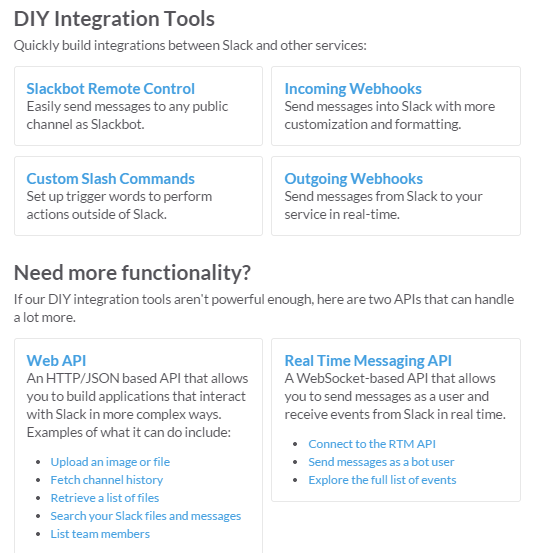
Slack has provided the tools because they understand that their website helps drive many organisations development teams. By including these tools they are giving there community the chance to implement more successful features which can later be incorporated into Slacks core functionality. Slack is providing a dynamic way for teams and employees to communicate, it is also allowing the community to grow its organisation and this has given them the opportunity to create a better service which suits everybody!
But what will it cost you, and businesses?
Slack has a freemium plan that includes up to five integrations (other web applications e.g. Dropbox) and 5GB storage. Premium pricing includes unlimited external integrations, and increments of 10, 20, and 50GB of storage and can be paid monthly or annually.
To conclude this blog post, I personally use Slack and can argue that it is one of the most valuable tools a business can implement especially if you are reporting, communicating and sharing information between employees in multiple places (geographical and workplace hierarchy) . It provides a great service for developers and the community benefits from their great work. Slack has only recently been launched and yet it is becoming one of the dominant Web 2.0 application available.
As always, thank you for reading my blog post, please leave your feedback and I look forward to connecting with you in the future.
 Jason Collier's Social Blogsphere